

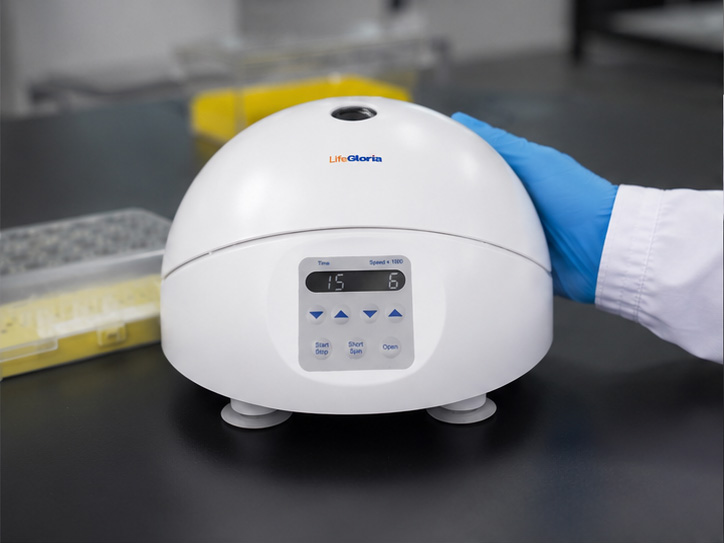
A chilled tube placed into a non-refrigerated centrifuge does not stay at a controlled temperature simply because it started cold. Buyers should distinguish sample-temperature requirements from bench footprint, speed and budget before choosing the instrument.
Quick Answer
Choose a non-refrigerated centrifuge only when the method permits its actual operating temperature. If a defined cold condition must be maintained, select a verified refrigerated configuration and validate sample temperature under the intended load. Do not assume a LifeGloria mini centrifuge or LC-318N has active refrigeration unless the exact supplied specification confirms it.
The LifeGloria Option
LifeGloria mini and LC-318N configurations can be considered for routine work whose temperature limits are compatible. The mini unit is intended for compatible microtube workflows; LC-318N supports more rotor choices. State a cold-control requirement clearly so our team can confirm a suitable offer or explain when the proposed model is not appropriate.
Explore Product Options · Request a Quote

Ask Whether Temperature Is a Requirement or a Preference
Write down the allowable sample range, maximum time outside storage and the endpoint affected by temperature. A method that specifies a cold centrifugation step should not be replaced by a room-temperature run merely to reduce purchase cost.
Compare the Systems Fairly
| Decision | Non-refrigerated | Refrigerated |
|---|---|---|
| Temperature control | No assumed active cooling | Active control within stated conditions |
| Typical buying focus | Routine approved ambient workflows | Defined temperature-sensitive workflows |
| Setup | Rotor and tube compatibility | Compatibility plus cooling preparation |
| Ownership cost | Often simpler to maintain | May add cooling maintenance and energy needs |
Actual temperature and cooling performance depend on model, rotor, room conditions, speed and load. A displayed chamber temperature is not automatically the temperature inside every sample.

Check the Whole Run, Not Only the Starting Condition
Consider repeated batches, long runs and warm rooms. The configuration that works for one short run may behave differently during a busy shift. Document the test conditions and use an approved temperature-validation method that does not create a rotating-load hazard.
Avoid Unsafe Cooling Workarounds
Do not place ice, dry ice, liquid nitrogen or unapproved cooling materials inside a rotor or chamber. Pre-cooling tubes is not a replacement for active control. Follow the instrument and sample method, and never modify the centrifuge to imitate a refrigerated model.
Buy for the Temperature and Vessel Together
Once temperature is settled, compare target RCF, tube size, samples per run, rotor options, adapters, noise and available space. Include voltage, local service, documents and freight. A cheaper centrifuge that cannot run the method is not a cost saving.
Build Your LifeGloria Inquiry
- Sample temperature limits
- run duration
- RCF
- vessel
- rotor capacity
- repeated batches
- required cooling capability

Frequently Asked Questions
Can a cold tube replace a refrigerated centrifuge?
Not when the protocol requires temperature to be maintained during the run.
Does high-speed mean refrigerated?
No. Speed and refrigeration are independent specifications.
Is the displayed temperature the sample temperature?
Not necessarily. Validate the sample condition using an approved approach.
How should I request a LifeGloria recommendation?
Provide the allowable sample temperature, duration, RCF, tube format, batch size and destination; ask for explicit written confirmation of cooling capability.
Recommended Next Step
Start your LifeGloria inquiry with the temperature limit, not only RPM. Where a non-refrigerated configuration fits the validated method, a matched mini or LC-318N setup can be a practical option; where it does not, keep the requirement rather than weakening the method.
Confirm the exact model, compatibility, certificates, operating limits and delivery terms before purchase. Use the manufacturer's instructions and your validated laboratory procedure.
