

After reviewing the workflow, the issue was not the reagents or the electrophoresis system. It was inconsistent sample mixing. Some tubes were briefly vortexed, others were mixed too aggressively, and several were not fully resuspended before centrifugation.
This is a common but often overlooked source of experimental variability. Even a high-quality laboratory vortex mixer cannot guarantee uniform results if mixing technique is inconsistent.

Incomplete Resuspension Before Vortexing
One of the most frequent mistakes is placing a pellet or precipitate into the vortex mixer without first loosening it manually.
When solid material remains compact at the bottom of a tube, vortexing alone may not fully resuspend it. This leads to uneven distribution of cells, proteins, or nucleic acids.
A brief flick, pipette resuspension, or short pre-spin mixing step often improves homogeneity before full vortexing begins.
Using Excessive Vortex Speed for Sensitive Samples
Many users assume that higher speed always improves mixing efficiency.
However, excessive vortex intensity can denature proteins, shear DNA, or damage fragile cells. This is particularly relevant in enzymatic reactions and clinical sample preparation.
A moderate and controlled mixing speed is usually sufficient for most biological workflows.
Insufficient Mixing Time
Short vortex durations are another common source of variability.
A quick one-second pulse may appear sufficient visually, but may not fully homogenize viscous buffers or concentrated solutions.
In many molecular biology applications, short repeated mixing cycles are more effective than a single brief burst.
Tube Position and Contact Angle Errors
Proper tube positioning is often ignored in routine workflows.
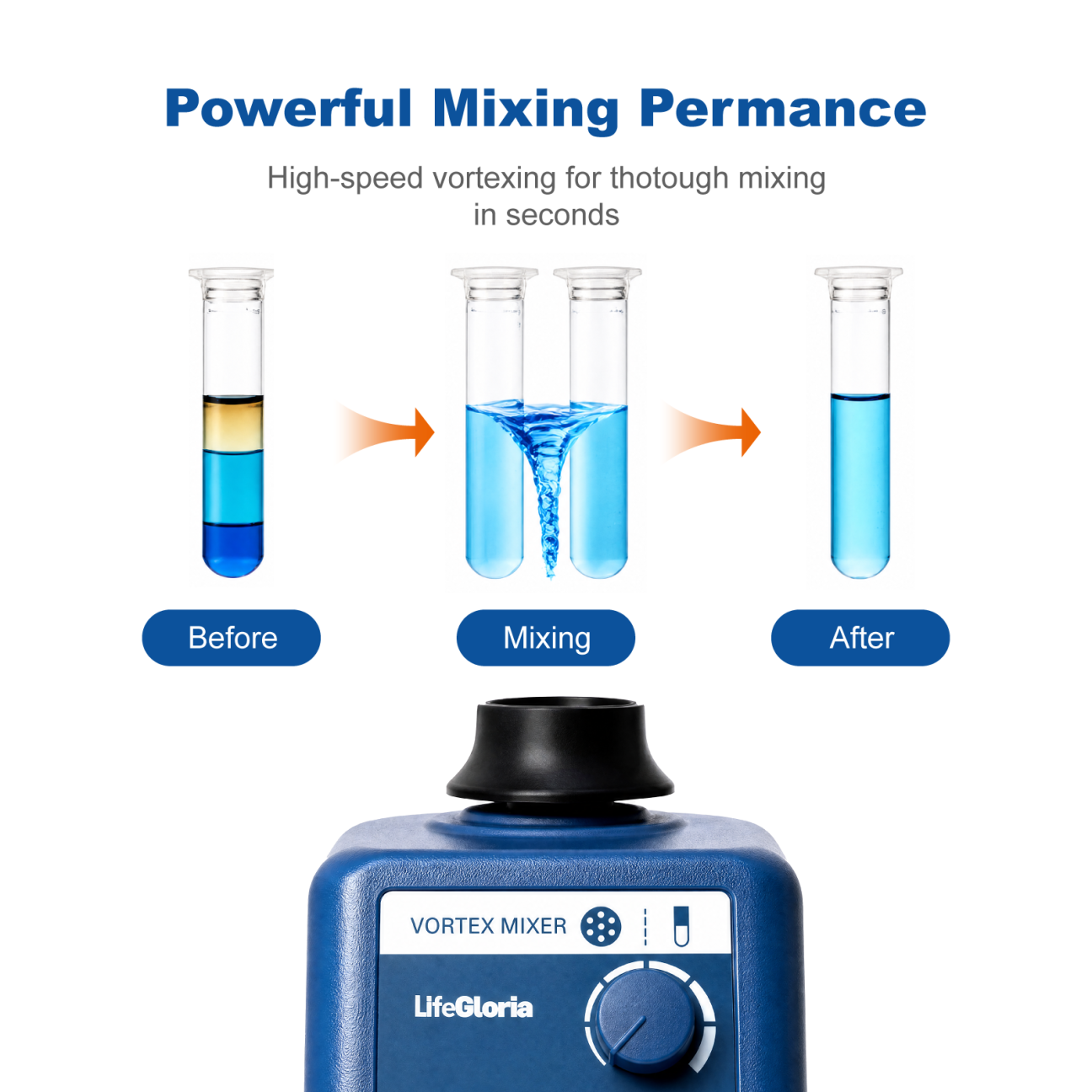
If the tube is not placed firmly in the center of the mixing head, energy transfer becomes uneven. This results in partial mixing or inconsistent vortex patterns.
Ensuring stable vertical contact improves reproducibility, especially when processing multiple samples simultaneously.
Overfilling or Underfilling Tubes
Sample volume directly affects mixing efficiency.
Overfilled tubes reduce vortex space and limit fluid movement, while underfilled tubes may not engage properly with the mixing motion.
Maintaining recommended working volumes ensures consistent vortex formation and predictable mixing performance.
Mixing Without Standardized Timing
Inconsistent timing between samples is a hidden but serious problem in batch experiments.
If one sample is vortexed for 3 seconds and another for 10 seconds, downstream variation is almost inevitable—even if all other conditions are identical.
Using standardized timing protocols or automated timers improves reproducibility across operators.
Ignoring Temperature Effects During Mixing
Cold or highly viscous solutions behave differently under vortex conditions.
Refrigerated buffers often resist homogenization, requiring longer or staged mixing cycles. Conversely, overly warm samples may foam more easily, affecting volume accuracy.
Allowing samples to equilibrate to working temperature can reduce these inconsistencies.

Poor Maintenance of the Vortex Mixer
Like all laboratory instruments, vortex mixers experience mechanical wear over time.
Aging rubber heads, weakened motor performance, or unstable base pads can significantly reduce mixing efficiency without obvious visual signs.
Regular inspection and maintenance ensure consistent energy transfer and prevent gradual performance drift.
A Practical Example From Routine Laboratory Work
In a teaching laboratory, students preparing bacterial suspensions for OD measurement showed large variation in absorbance readings despite identical protocols.
Investigation revealed that some students vortexed samples briefly by hand, while others used continuous high-speed mixing. Additionally, tube placement varied between operators.
After standardizing vortex time, speed, and tube positioning, variability between measurements decreased significantly without any change in reagents or equipment.
The conclusion was clear: mixing technique strongly influences experimental reproducibility.
Choosing a Vortex Mixer for Laboratory Applications
When selecting a laboratory vortex mixer, speed stability, vibration control, operation modes (touch vs continuous), and compatibility with different tube sizes are all important considerations.
For high-throughput laboratories, consistent performance under repeated use is especially critical, as small fluctuations in mixing efficiency can accumulate across large sample sets.
Final Thoughts
Accurate laboratory results depend not only on reagents and instruments, but also on seemingly simple steps like mixing.
Standardized vortexing technique—controlled speed, proper tube placement, sufficient mixing time, and regular equipment maintenance—can significantly improve reproducibility across experiments.
For research laboratories, universities, and clinical facilities seeking stable and reliable mixing performance, LifeGloria laboratory vortex mixers are designed to deliver consistent motion control, low vibration operation, and dependable daily performance across a wide range of molecular biology and diagnostic workflows.
