


A centrifuge can complete a separation process in minutes. However, one small mistake can destroy samples that took weeks to prepare.
Many laboratory technicians focus on rotor speed and centrifugation time. In practice, sample handling, balancing, and maintenance often have a greater impact on experimental success. The following mistakes appear repeatedly in university laboratories, biotech companies, and clinical testing facilities.
Mistake 1: Loading Tubes Without Proper Balance
An imbalance is one of the most common reasons for abnormal vibration or automatic shutdown.
For example, a technician places a 50 mL tube opposite a partially filled tube without checking the weight difference. At 15,000 rpm, even a small imbalance creates significant mechanical stress.
Before every run, weigh opposing tubes instead of estimating by eye. When an odd number of samples is unavoidable, prepare a balance tube with water or buffer at the same mass.
Mistake 2: Using the Wrong Centrifugal Force
Many protocols specify relative centrifugal force (RCF), but users sometimes enter only RPM.
This difference matters because RCF depends on rotor radius. Two centrifuges operating at the same RPM may generate different separation forces.
When isolating plasmid DNA or pelleting bacteria, always verify that the required RCF matches your rotor configuration instead of copying another laboratory’s RPM setting.
Mistake 3: Opening the Lid Immediately After the Run
Researchers often rush to remove samples. In high-speed applications, sudden movement can disturb loosely packed pellets.
Blood components, yeast cells, and bacterial pellets may partially resuspend if tubes are handled roughly.
Wait until the rotor stops completely and remove tubes gently while keeping them upright.
Mistake 4: Ignoring Rotor Surface Damage
Rotor inspection is frequently overlooked during busy laboratory schedules.
Small scratches, chemical residue, or corrosion around tube holes can become serious structural problems after repeated high-speed cycles.
Wipe the rotor after every use and inspect it under good lighting. If cracks or deep corrosion appear, discontinue use immediately and replace the component.
Mistake 5: Filling Tubes Beyond Their Recommended Capacity
Overfilled tubes increase the risk of leakage and cap failure.
This issue becomes particularly important during nucleic acid extraction or protein preparation, where contamination may affect downstream PCR or electrophoresis results.
Leave sufficient headspace according to the tube manufacturer's recommendation rather than filling to the very top.
Mistake 6: Choosing Excessive Braking for Sensitive Samples
Modern centrifuges often allow users to adjust acceleration and braking profiles.
Fast braking saves time but may disturb gradients or loosely packed sediments.
For density gradient centrifugation or fragile cell preparations, selecting a slower deceleration setting often produces cleaner layer separation and more reproducible results.
Mistake 7: Skipping Routine Cleaning and Maintenance
Dust, spilled buffers, and salt deposits gradually reduce equipment reliability.
A simple maintenance checklist can prevent many unexpected failures:
- Clean the chamber after daily use.
- Inspect rotor attachment points weekly.
- Verify tube adapters fit securely.
- Check for unusual vibration or noise.
- Record maintenance activities in a laboratory log.
These practices require only a few minutes but may significantly extend equipment life.
Practical Example From Sample Preparation
During a protein extraction workflow, a laboratory team centrifuged lysates after three weeks of sample collection. One adapter was installed incorrectly, creating uneven loading. The centrifuge stopped automatically because of imbalance protection before reaching full speed.
Although the equipment prevented mechanical damage, several samples had to be processed again because delays affected downstream scheduling. The incident highlighted that careful setup before pressing “Start” is often more important than running at the highest possible speed.
How to Select a Reliable Laboratory Centrifuge
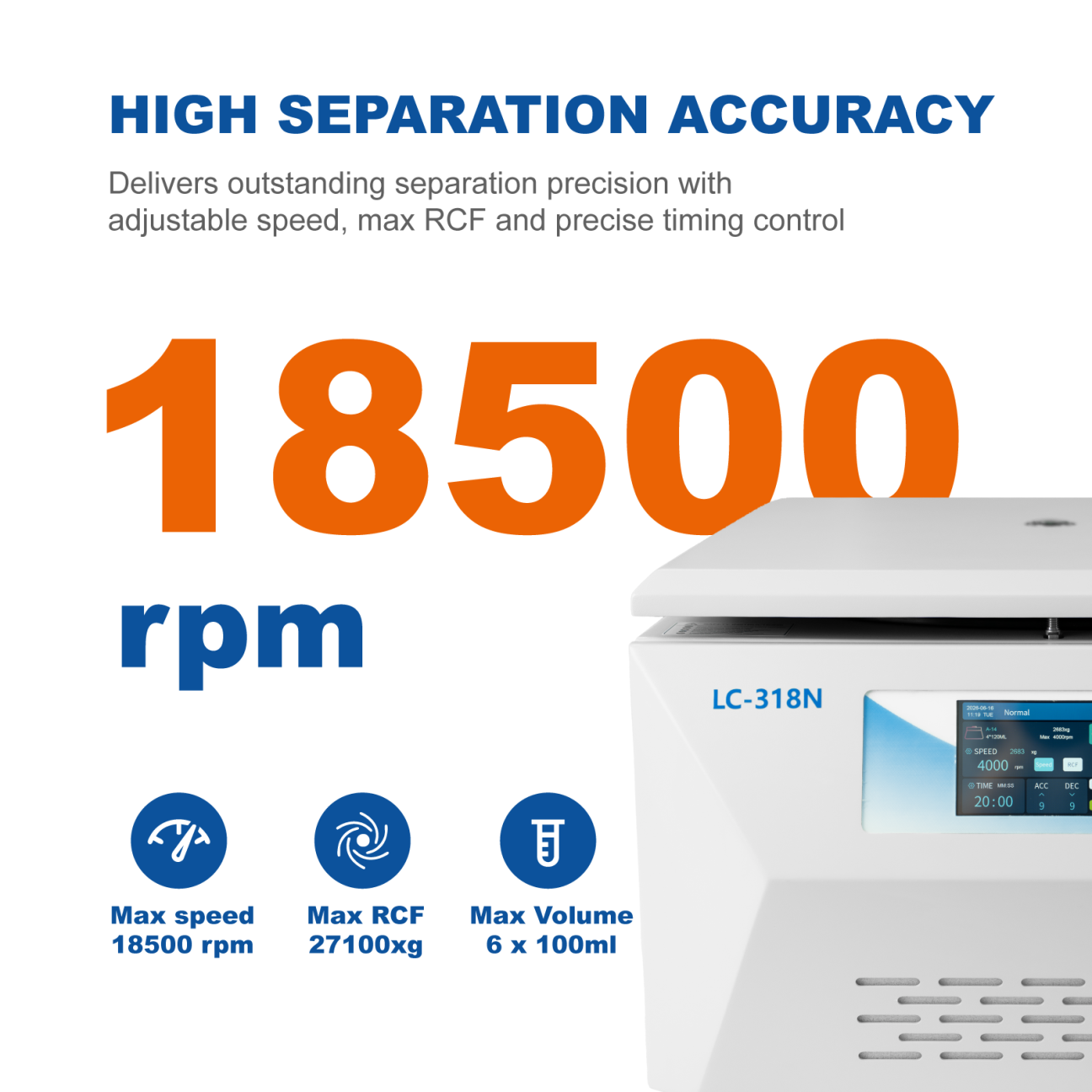
When evaluating a centrifuge, speed is only one consideration.
Stable motor control, low vibration, intuitive operation, safety interlocks, and dependable imbalance detection all contribute to consistent laboratory performance. Compatibility with commonly used tube sizes and easy rotor maintenance are also valuable for daily workflows.
Final Thoughts
Successful centrifugation depends on more than selecting a high RPM value. Balanced loading, correct force selection, careful handling, and routine maintenance all protect valuable samples and improve reproducibility.
For laboratories seeking dependable benchtop solutions, LifeGloria designs centrifuges with features such as high-speed operation, wide voltage compatibility, low-noise performance, and safety-focused engineering to support research, education, and clinical applications without interrupting demanding workflows.
