

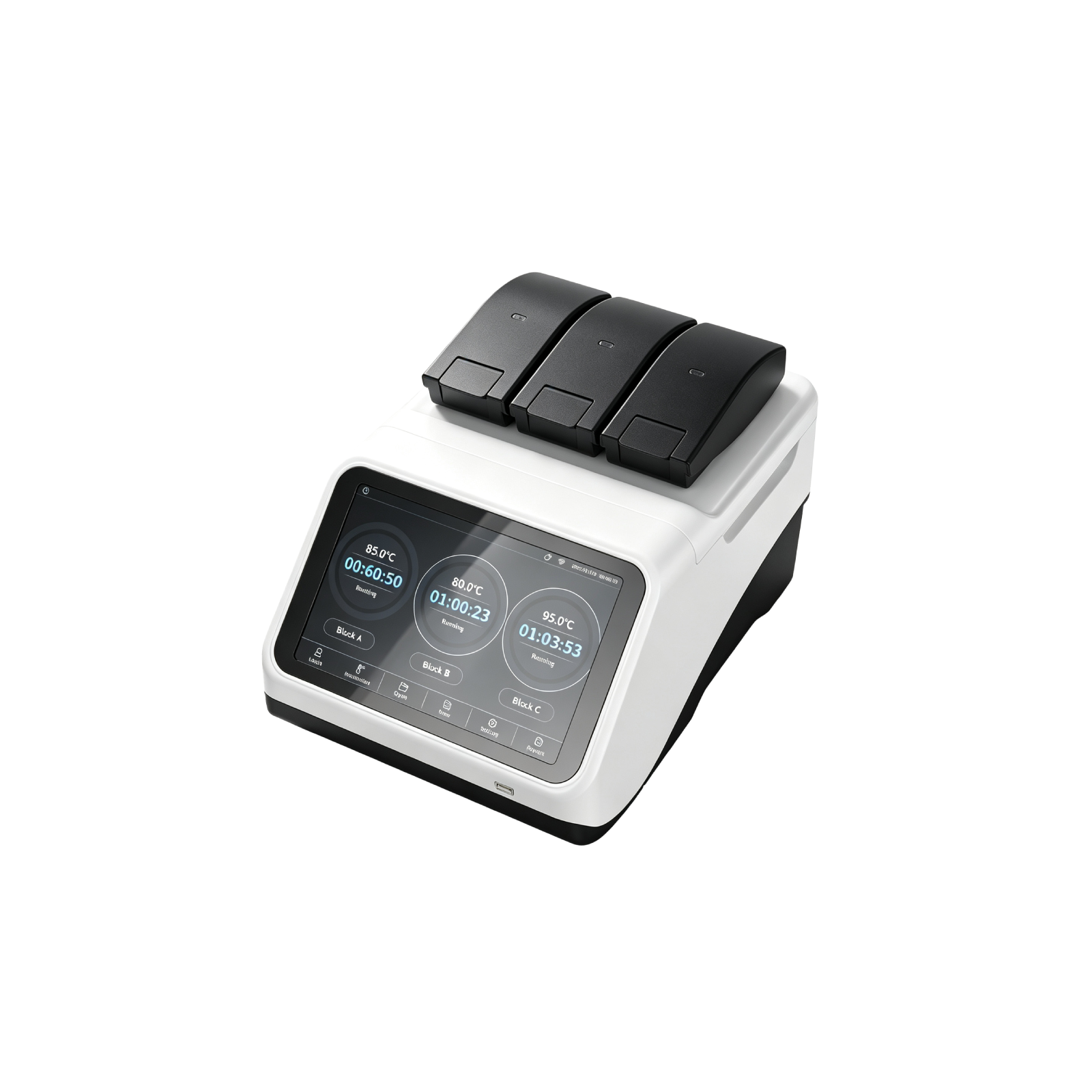
Quick answer: A practical PCR setup sequence is: prepare a clean work area, calculate and label reactions, pipette master mix and templates with fresh tips, mix only as strongly as the assay permits, briefly spin liquid to the bottom, then load the validated thermal-cycler program.
PCR reliability depends on the complete pre-analytical workflow, not only the thermal cycler. Small volume errors, aerosols, poorly mixed reagents, and droplets on tube walls can all increase variation.
A coordinated setup can use a precision pipette, vortex mixer, and mini centrifuge before amplification in the appropriate PCR workflow.
In this guide:
- Clean-zone preparation
- A repeatable setup sequence
- When to vortex and when not to
- Contamination controls
Prepare the Work Area
- Separate pre-amplification and post-amplification materials
- Clean the work surface according to the laboratory SOP
- Thaw and handle reagents as specified by the assay
- Label tubes or plates before adding sample
- Use dedicated, calibrated pipettes where required
A Repeatable Setup Sequence
- Calculate reaction and master-mix volumes with an allowance for pipetting loss
- Prepare the master mix in a clean area
- Aliquot master mix into tubes or plate wells
- Add template using a fresh tip for every sample
- Close tubes or seal the plate
- Mix according to assay instructions
- Perform a brief spin-down to collect liquid
- Load the correct thermal-cycler program and verify sample positions
Vortex, Pipette-Mix, or Invert?
| Method | Use when | Main caution |
|---|---|---|
| Vortex | Reagent is compatible with rapid mixing | Avoid excessive foam or aerosols |
| Pipette-mix | Small volume needs controlled local mixing | Avoid bubbles and cross-contamination |
| Gentle inversion | Fragile or foam-prone material | May be insufficient for very small reaction volumes |
Follow the reagent or assay instructions. Do not assume every enzyme mix should be vortexed.
Reduce Contamination and Variation
- Use filtered tips when required
- Change tips between every sample and reagent transfer that could cross-contaminate
- Keep tubes closed except during addition
- Include positive, negative, and no-template controls as the method specifies
- Record lot numbers, pipettes, program version, and deviations
The cycling temperature and time profile is assay-specific and should not be replaced by a generic blog setting.
Frequently Asked Questions
Should PCR master mix be vortexed?
Only if the reagent instructions allow it. Some mixes tolerate brief vortexing; others should be mixed gently.
Why spin PCR tubes before cycling?
A brief spin moves droplets from walls and caps to the bottom so the full reaction volume is in the intended thermal zone.
Can the same pipette be used before and after amplification?
Many laboratories dedicate equipment to separate zones to reduce amplicon contamination. Follow the site contamination-control plan.
Key Takeaway
Standardize the order of work, not just the instrument settings: clean, calculate, pipette, mix, spin, verify, and cycle.
